


About LASA2027
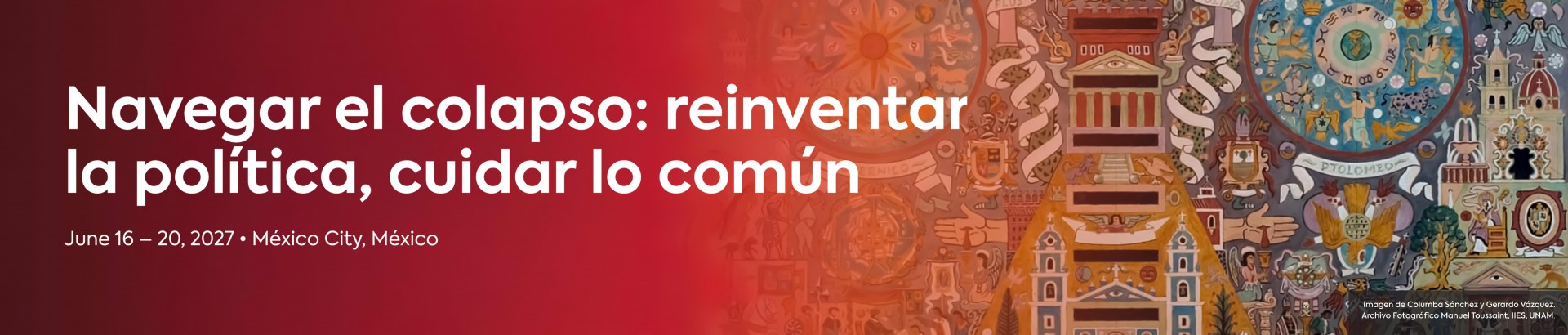
Navegar el colapso: reinventar la política, cuidar lo común
Over the past decade, phenomena have emerged with unprecedented speed representing setbacks that until recently were unthinkable, with harmful effects on citizens’ rights, democratic standards, and the rule of law. In this context, numerous armed conflicts and reconfigurations of world order have added layers of collapse and civilizational crisis. However, if we look more closely, beyond the stupor, we can see that new progressive experiences are taking place simultaneously. These emerging phenomena are observed in a variety of contexts at the macro, meso, and micro levels of analysis. In this Congress, we seek to engage with the multiple dimensions of collapse without focusing solely on it, but also to learn and discuss innovative actions, strategies and initiatives that help us navigate this collapse and move beyond it.
On one hand, we are witnessing the emergence of new alliances among countries that are reshaping the global geopolitical balance in the military, technological, and financial spheres. These transformations range from collective mandates to polling mechanisms, including new forms of digital consultation and deliberation. Additionally, democratic innovation has consistently sought, in successive waves, to address the decline of traditional political representation, yielding results that range from resounding failure to outstanding contributions. Paradoxically, their impact depends on the strength of traditional political movements and civil societies with which these initiatives are associated.
Furthermore, additional proposals have emerged from social and organizational mobilization itself, ranging from innovative activism in support of fiscal justice to transnational coalitions operating both within and beyond digital networks. Specifically in the digital domain, we are witnessing a true revolution based on advances in artificial intelligence that impacts not only public policies and social activism, but also the configuration of growing post-human or biodigital societies and cultures. Finally, in the same context, in contrast to the ultraconservative and dehumanizing dystopias, new future society programs are emerging based on the care paradigm (CEPAL 2025). This roadmap to a caring society draws on both institutional efforts by governments and international cooperation, as well as community initiative.
This Congress proposes opening a space to question, discuss and analyze these nascent fields of experience that today enable us —or suggest the possibility — to reinvent politics and care for the common good. We believe this discussion should encourage people to seek out emerging spaces for resistance and social and political innovation, while weighing the growing obstacles and setbacks. In other words, we maintain that structural transformations denote collapses that must be “navigated, without erasing future horizons, provided that the current storms are not dismissed. This is the only way we can discuss and learn about the real potential of what we must do. Navigating the collapse invites us to understand both the force of the waves that may sink us and the paths that lead to new ports.
Thus, we propose focusing on two main points. We start with the conviction that without political mediation there can be no civilized conflict resolution, and that without caring for the collective good, the tragedy of the common man is no longer a theoretical prediction but rather becomes an empirical reality. Therefore, using this forum to find a mutual space to reflect and discuss the future is not only relevant, but also a necessary and promising endeavor.
Accelerated transformations: geopolitics, technology and inequality
These new experiences are emerging in a context marked by far-reaching social, economic, political and cultural transformation. Latin America and the Caribbean are not strangers to these dynamics. The region simultaneously experiences the impacts of geopolitical restructuring, rapid technological changes and growing inequalities.
On the geopolitical front, the military, political, diplomatic, financial and even technological hegemony of the United States is showing signs of waning given the rise of China —and other Asian alliances— as well as the persistence of Russia. After the end of the Cold War, disputes were no longer organized around opposing ideological frameworks, shifting toward the internal dynamics of informational or platform capitalism, characterized by the central role of data, digital infrastructure and technology companies.
The fast technological evolution, continuous innovation and expansion of artificial intelligence are reshaping both the economic sphere and social and cultural life, as well as environmental sustainability. However, this dynamism coexists with global deepening of inequality. In Latin America, considering the footprint of the colonization process and, in that regard, the persistence of alarming levels of racism, the concentration of wealth is particularly extreme: the wealthiest 10% earn, on average, 12 times more (versus a 4:1 proportion in OECD countries). One in every five residents of the region is still living in poverty (CEPAL et al., 2023). Meanwhile, the technological revolution presents great challenges for a region that has developed economies based on the over-exploitation of raw materials (petroleum, lithium, etc.). This increases the risk of worsening the environmental crisis in the region and the world. This perverse coexistence of development promises based on a biodigital society and the persistence of intersectional inequality, along with the growing environmental crisis, merits particular attention.
Erosion of post-war agreements and weakening of the State
In addition to these dynamics, the fundamental agreements that characterized the post-war order of the 20th Century are rapidly eroding. Welfare states, which vary widely across the region and have been eroding since the crisis of the 1970s, and due to the structural reforms in Latin America and the Caribbean in the 1990s, today face even greater weakening. Even the fiscal agreements that sustain the nation-states are under pressure.
New economic elites, in many cases political leaders, shirk their public responsibilities, evade or abandon their tax commitments, leading to a scenario of weakened or dismantled states. This seriously compromises the capacity of the State to guarantee rights and provide public benefits.
At the same time, another fundamental agreement —that of human rights derived from the Universal Declaration of 1948 and the International Covenants of 1966— is also threatened. Escalating conflicts, migration crises, increasing autocratic tendencies and the influence of powerful and criminal forces are severely straining these regulatory frameworks.
Polarization, democratic decline and withdrawal from the public sphere
The modern paradox is that, despite the uniformity of geopolitical disputes after the end of the Cold War, polarization is growing within nation-states. As the States deteriorate, so do democratic regimes. Elites are increasingly withdrawing from public life while becoming more entrenched, while broad segments of the population are distancing themselves from the exclusive decision-making circles (Urbinati, 2023). This weakens traditional forms of intermediation —parties, unions, corporations— and increases distrust, skepticism and anti-political sentiments, with special emphasis on Latin America and the Caribbean.
In this climate, ultra-conservative, anti-right coalitions proliferate, which have local roots and diverse national expressions, winning elections and regressively transforming democracy from inside democratic institutions. These coalitions invoke the concept of the heteronormative family as a symbolic and material solution to the dismantling of the State and social rights. When the democratic State cannot provide guaranteed rights, it is the family —and especially women— who absorb this burden, deepening the gendered division of labor, which further deteriorates democracy by increasingly excluding more than half of the population from public-political life, reinforcing their subjugation to the reproductive sphere (Tronto 2013).
Regressive redefinition of citizenship and those who can be killed
Conservative anti-rights initiatives also undermine the notion of citizenship understood in the framework of human rights and welfare states. They propose that only certain groups —men, whites, those with resources, “from good families”— are worthy of full citizenship. The excluded groups —migrants, indigenous peoples, people of African descent— therefore become those who can be killed–reduced to “bare life” (Agamben 1998), people whose lives are outside of the protection of the State infrastructure and under its police, military and paramilitary control, even in coordination with national and global criminal actors.
The dismantling of the State is thus accompanied by a narrowing of the population considered “worthy” of rights, property and public services, as well as protection of life itself.
Between uncertainty and possibility: looking at the new without paralyzing nostalgia
Uncertainty, discouragement and the erosion of future plans can undermine the collective capacity to imagine alternatives and recognize the transformative potential of the new. Is it possible we are not fully perceiving new experiences and possibilities because we long for the past or fear future uncertainty?
This is precisely why this Congress proposes to bring us together to examine the present through the lens of possibility and emerging trends, rather than focusing on the central collapse. We propose doing so without naively denying the collapse. Recognizing the initiatives that reinvent politics and care for the common good —and the obstacles and challenges we face— is a key part of the intellectual and political we seek to advance through this encounter.
| Levels of analysis | Transformations of the global order (collapses) | Emerging phenomena (innovation) |
|---|---|---|
| Macro | Geopolitical restructuring (United States, China, Russia) and its implications in Latin America and the Caribbean. | China’s advances in financial and technological innovation. |
| The end of the Cold War: deterioration of Welfare States and the Human Rights Covenant. | The transformation of alliances in Latin America and the Caribbean given the USMCA. Multi-front wars and the transformation of military power. The reordering of middle powers. |
|
| The technological revolution and its economic, social and cultural impact; platform capitalism, digital capitalism, technological feudalism, digital finance phase of capitalism. | New strategies and plans for access to knowledge. Technology regulation and redistribution proposals. | |
| The worsening environmental crisis and the extraction of primary goods. | New indigenous, Afro and other forms of activism. | |
| The impact of transhumanism, biodigital society and dehumanization (those who can be killed, disposables), on notions of citizenship and rights. | New languages and forms of human and post-human activism. | |
| Meso | The decline/dismantling of States (capacities, administrations, public-social policies, erosion of fiscal-tax agreements). | Fiscal activism; possibilities and obstacles to redistribution. |
| The decline of democratic systems (growth of autocratic tendencies). | Collective mandates. Polling vs. deliberation. |
|
| The decline of traditional representation/mediation: antipolitical attitudes, distrust and loss of legitimacy of political parties, unions, corporations. | The renewal of democratic innovations: changes in light of assessments of democratic innovations since the 2000s. | |
| Few versus many: flexible yet entrenched elites; withdrawal from public life; mass, digital mobilization without intermediaries. | The transformation of the elites: flexible and entrenched networks. | |
| The compensatory role of the heteronormative family amid State adjustment and decline. | The Caring society versus dehumanization (incidence at the macro level). | |
| The growth of anti-rights ultraconservatism. | Resistance and innovation to counter anti-rights ultra-conservatives. | |
| Micro | New forms of subjectivity. | Post-human identities. |
| Changes in religious adherence and spirituality. | The expansion of conservative neopentecostalism versus new hybrid expressions: between pro-rights activist subjectivities (i.e., feminist, human rights) and progressive religious activist subjectivities. | |
| Changes in discourse. |
The rise of manospheres, incels versus the deconstruction of masculinity. The rise of tradwives, tradfems versus new expressions of dissident sexualities. |
References
Agamben, Giorgio. 1998. Homo Sacer: Sovereign Power and Bare Life. Traducido por Daniel Heller-Roazen. Stanford: Stanford University Press.
Chancel, Lucas, Thomas Piketty, Emmanuel Saez, y Gabriel Zucman. 2022. Informe sobre la desigualdad global. World Inequality Lab. Licencia Creative Commons 4.0.
Comisión Económica para América Latina y el Caribe (CEPAL). 2025. La sociedad del cuidado: Gobernanza, economía política y diálogo social para una transformación con igualdad de género. Santiago: CEPAL.
Güezmes García, Ana, Nicole Bidegain Ponte, y María Lucía Scuro. 2023. “Igualdad de género y sociedad del cuidado.” Revista de la CEPAL 141: 179–192.
Tronto, Joan C. 2013. Caring Democracy: Markets, Equality, and Justice. New York: New York University Press.
Urbinati, Nadia. 2023. Pocos contra muchos: El conflicto político en el siglo XXI. Buenos Aires: Katz Editores.